Our founder, Aukje, recently returned from a once-in-a-lifetime trip to Kenya. Along the way, she met travel expert Dalia Militaru. They instantly connected over a shared passion for nature and a desire to redefine what sustainable travel actually looks like.
Having documented the journey, we invited Dalia to share their collective experience. Here is her honest account.
The Complexity of an Iconic Landscape
The Maasai Mara is one of the most iconic wildlife landscapes on Earth, but also one of the most complex destinations to navigate responsibly. We went in the low season, with a local partner who shares our values, and we came back with a deeper clarity for what nature-positive tourism can look like in the region.
Here are our key takeaways from the trip, which we hope will inspire other travel professionals and travellers alike.
1. The Reality We Can’t Ignore
It’s important to us to address one critical aspect up front.
Arriving in the Mara when you work in responsible tourism is a complicated feeling. The beauty is immediate, and so is the weight of what you know.
The Great Migration – 1.5 million wildebeest making their annual loop – is one of nature’s most extraordinary spectacles. But in peak season, the crossing points are lined with dozens of vehicles, engines running, cameras pointing at animals that are already battling crocodiles. In this environment, herds hesitate. Ancestral migratory patterns, repeated for millions of years, are disrupted by the sheer weight of human desire to be close.
We felt that quiet sadness upon arrival: a stark reminder that the line between awe and impact can be thin. The Mara is fragile, but it is also resilient. The difference between those two outcomes depends almost entirely on us.
2. The Shoulder Season Changes Everything
We travelled in December after the migration had moved on, before the next wave of peak visitors and spent our next 5 days in the conservancies such as Naboisho and Mara North, where we were the only vehicle for kilometres.
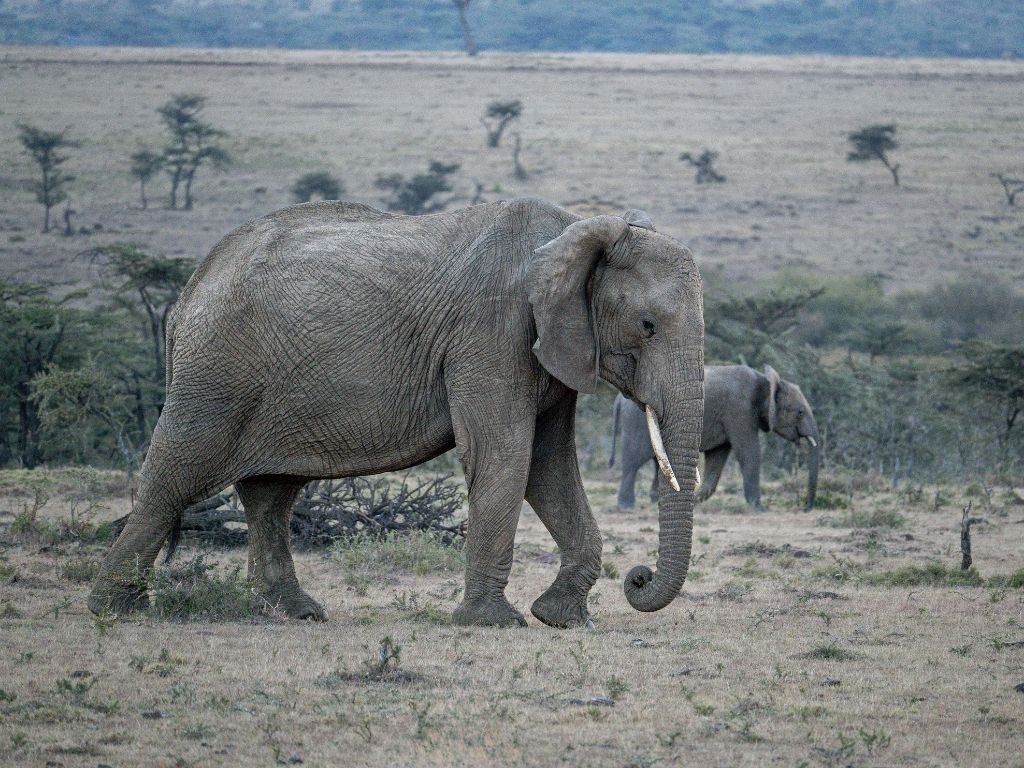
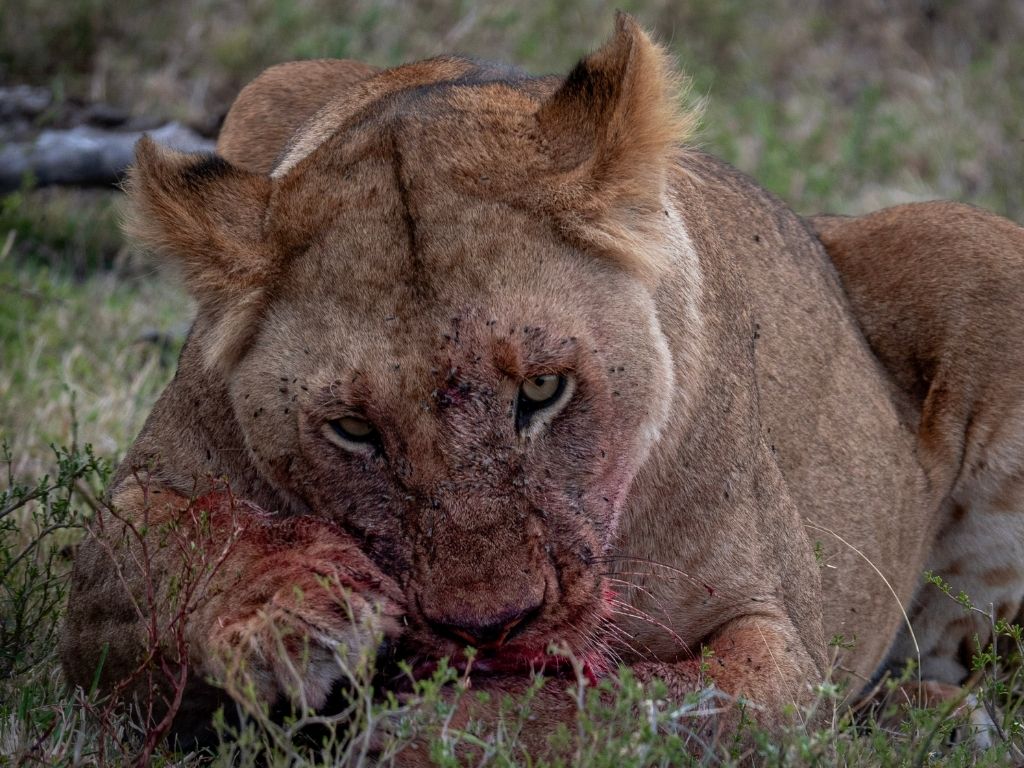
Here, we’ve witnessed two lionesses with a fresh kill, unhurried. A cluster of hyenas calling and circling, waiting for their moment. Elephants crossing slowly with calves tucked close, completely unbothered. And a few hundred wildebeest, the ones who stayed behind, grazing quietly as if the season’s spectacle had nothing to do with them.
This is what the Mara looks like when tourism gets out of its own way, and it should not be the exception.
3. Conservancies Matter, Here’s Why
Conservancies are areas of community and privately managed land that sit alongside (and sometimes buffer) the main reserve. Done well, they tend to come with clearer rules, stronger accountability, and practical caps that reduce “swarming” at sightings.
They also change the economics. National Geographic describes how, in the Maasai Mara, conservancy models can provide Maasai landowners with lodge rental fees and per-guest nightly payments, creating a direct incentive to keep land open for wildlife and coexistence, rather than conversion.
(Like anything, quality varies by operator and governance. The point is not that “conservancies are perfect,” but that they can create the conditions for better outcomes for wildlife, communities, and the experience itself).
MOYO Tip: If you’re planning around the migration, consider a “slow safari” approach: fewer camp moves, longer stays, and less hopping by bush flight.
4. Walk the Land – Don’t Just Watch It
The highlight of the trip was the walking safari. And it was not what we expected.
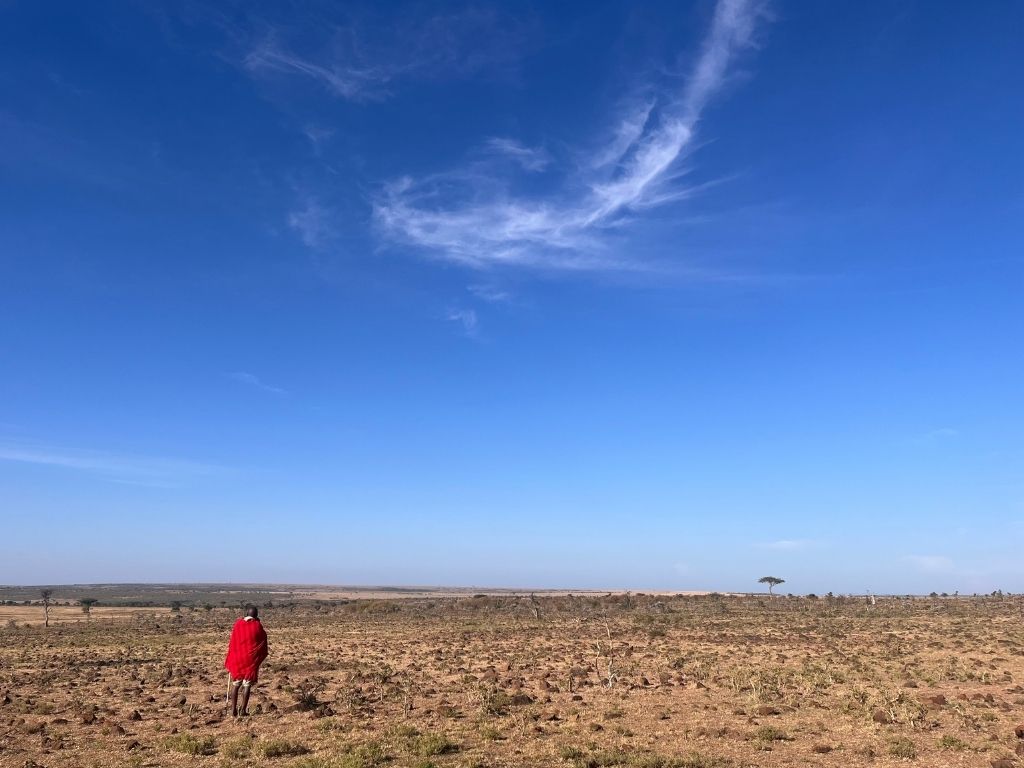
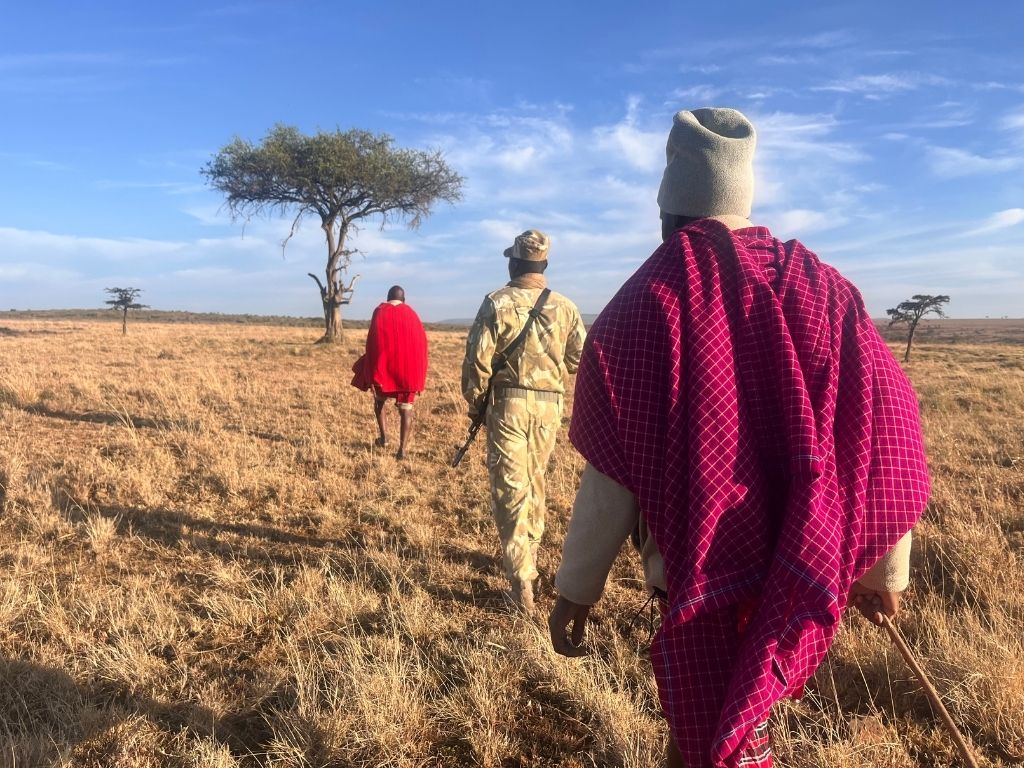
We walked with our Maasai guide, a community ranger, and an armed wildlife ranger. And the moment we stepped out of the camp, the landscape changed.
On foot, you feel the wind, you notice how sound carries and become aware of your pace and your place in the scene. You stop consuming the wild and start relating to it.
Our guide explained how acacia trees communicate, releasing chemical signals when a giraffe begins to feed, warning neighbouring trees to increase their tannins before the animal moves on. How plants and animals have adapted not in isolation but in relationship with each other, shaping and being shaped by everything around them.
Walking on ground that belongs to lions, elephants, and buffalo brings a certain degree of vulnerability and respect. You feel, genuinely, like a guest in someone else’s home.
MOYO Tip: If your operator offers a walking safari, say yes. There is no better way to understand what it means to be a visitor in this landscape. We even specifically designed a walking safari in the Mara for this purpose. .
5. The Maasai are Not a Backdrop
Our guide and camp staff were all from the local Maasai community. They read the landscape the way one reads a native language: a shift in herd behaviour that indicated a predator passed through hours earlier, the specific grasses that signal water below the surface, the precise quality of light at dusk.
The open savannah corridors that allow this ecosystem to function exist because of centuries of Maasai pastoral practices. The animals and the Maasai did not exist despite each other; they co-evolved.
Spending time with the guides who carry that knowledge, who see the landscape not as a backdrop but as home, is one of the most profound things travel can offer.
Our local partner has built their entire model around the communities they work alongside. Their guides and camp staff are local. Their camps sit within private conservancies where fees go directly to Maasai landowners, and a portion of every booking funds community projects in the Talek region.
One of those is a women’s collective that has been running since 2003, which began as a small effort to create sustainable livelihoods and has grown into a community of nearly 200 Maasai women artisans crafting jewellery and leatherwork that carries centuries of identity in every bead.
MOYO Tip: If you want to respectfully engage with Maasai culture while you’re here, seek experiences that are community-led, consent-based, and fairly paid, and avoid anything that feels staged for performance. A good operator should be able to tell you exactly how visits are organised and who benefits.
5. Sticking to Your Values in Moments of Discomfort
We want to share something that matters because, in responsible travel, the most important moments are rarely the ones you planned for.
One afternoon, we watched lionesses moving toward dense bush with their cubs. The atmosphere shifted—that quiet focus that precedes a hunt. Moments later, we heard the sounds of a kill. Other vehicles began to edge closer, and our guide instinctively started to follow suit.
We felt an immediate and intense discomfort. Not because anyone was doing something obviously ‘’wrong’’ but because we recognised the familiar slope: how quickly a wild moment can turn into a collective chase, how easily proximity becomes the prize.
We told our guide we didn’t need to follow and that we were happy to listen from a distance. We stayed back and then moved on without pursuing the scene.
We asked our guide to stop. We chose to listen from a distance, then moved on without pursuing the scene. It was a small decision, but it felt like the whole point. Ethics on safari aren’t proven in brochures; they are tested in the seconds when the pressure arrives, other vehicles move in, and the temptation is to join the “pull”. But we chose to hold the line.
It left us with a question, for ourselves and for the industry, that we keep coming back to: Even when an operator shares your values, what protects those values in real-time?
MOYO’s Mara Guide: How to Go Consciously
After taking some time to reflect on our trip, we came up with 5 top tips for anyone planning a trip to this precious place.
- Choose a private conservancy over the main reserve.
Vehicle numbers are capped, wildlife viewing is managed ethically, and fees go directly to Maasai landowners. You will often be the only vehicle at a sighting. Worth every extra penny.
- Travel in the low season.
December through March, and May through June. Extraordinary wildlife, far fewer visitors, lower rates, and a quality of presence that peak season cannot give you.
- Do the walking safari.
There is no better way to understand what it means to be a guest in this landscape. It will change how you see everything else on the trip.
- Ask real questions before you book.
Do they employ local Maasai guides? What is their vehicle policy at sightings? What community projects do they fund? The right operator answers these without hesitation.
- If you witness the migration, apply the 4D Framework.
Distance, Duration, Density, Directional Freedom. Wildlife should always have a clear exit. If your operator doesn’t know what that means, find a different one.
The Maasai Mara is one of the last places on Earth where the wild world operates at full scale. It is extraordinary. It is fragile. And it is absolutely worth protecting through every choice we make as travellers and as operators.
We came back with full hearts and a renewed sense of purpose. This is exactly why MOYO Nature Travel exists to connect people to experiences like this, with partners who care as deeply as we do.
Words and images by Dalia Militaru. Images by Aukje van Gerven. Edited by Hayley Whyte.
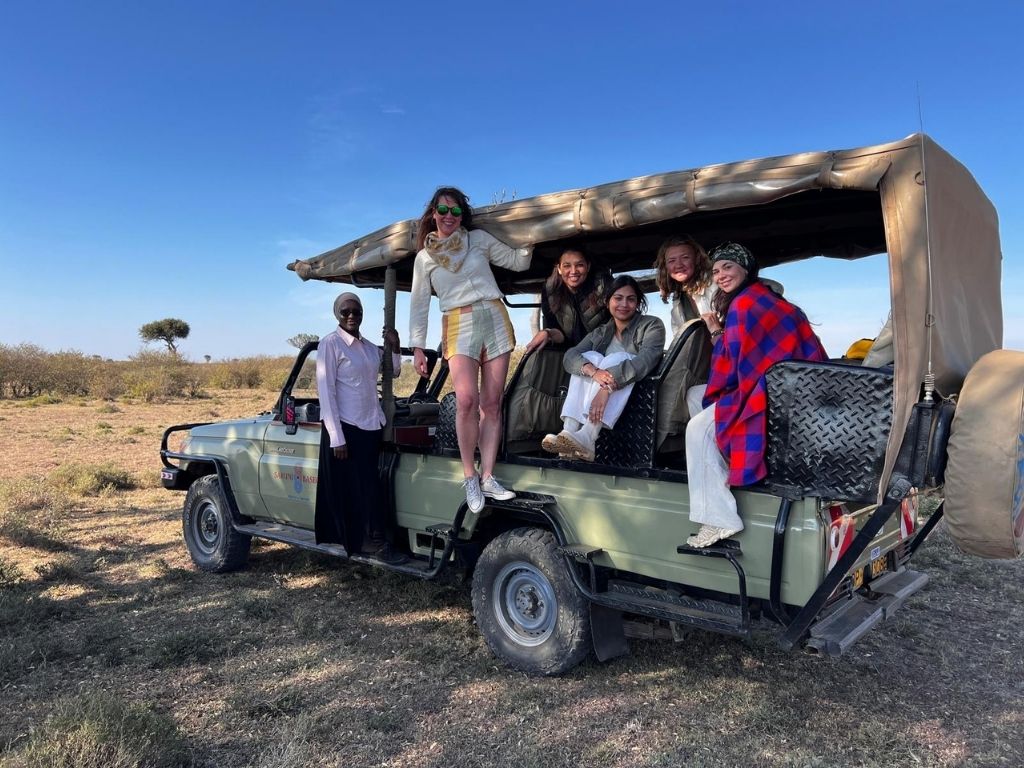
Curious about a nature positive experience in the Mara or somewhere else in the world? Sign up for our newsletter or get in touch. We would love to take you there, the right way.